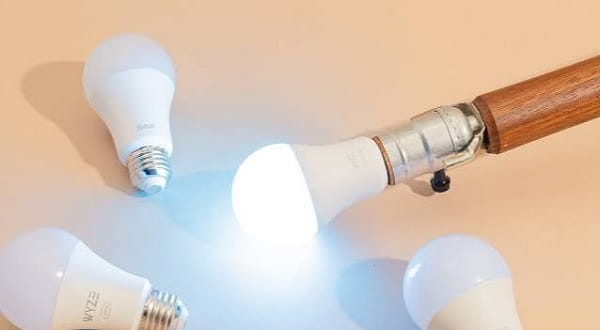
You switch off the bedroom light, settle into bed and notice a faint flash from the ceiling every few seconds. Sometimes the LED bulb glows weakly instead of becoming completely dark. It can feel mysterious because the wall switch is clearly in the off position.
This behaviour is commonly called LED ghosting or off-state flickering. LED bulbs need very little electricity to produce light, so even a tiny current passing through the circuit may charge the bulb’s internal components. Once enough energy builds up, the bulb flashes briefly and begins charging again. The cause may be a switch, dimmer, wiring condition or ageing bulb rather than a major electrical failure.

A Small Leakage Current May Still Be Flowing
Turning off a wall switch does not always mean that absolutely no current is reaching the bulb. Certain electronic switches allow a tiny amount of electricity to pass through their internal circuits.
An incandescent bulb would not react visibly to such a small current. An LED bulb is much more sensitive, so it may produce a faint glow or occasional flash.
The effect is usually easier to notice at night because the room is completely dark.
An Illuminated Switch Can Cause Ghosting
Some wall switches contain a small locator light that helps people find the switch in darkness. This indicator may draw power through the lighting circuit while the main light is off.
That small current can be enough to charge the LED driver. The bulb may then glow continuously or flash at regular intervals.
If the problem began after installing an illuminated switch, ask a qualified electrician to check whether the switch is compatible with LED lighting. Certain modern illuminated switches are designed to prevent this issue.
The Dimmer May Not Be Compatible With LEDs
An older dimmer designed for incandescent or halogen bulbs may not work properly with low-wattage LED lamps. Even in the off position, its electronics may allow enough current to pass for ghost flickering.
Confirm that both the bulb and dimmer are marked as LED-compatible. A bulb labelled “dimmable” can still behave poorly with an unsuitable dimmer.
When several bulbs are controlled together, the total electrical load must also fall within the dimmer’s supported LED range. Too little load may cause flickering, buzzing or failure to switch off fully.
Nearby Wiring Can Induce a Small Voltage
Electrical cables often run beside one another inside walls or conduits. A live cable positioned close to the switched lighting wire may create a small induced voltage.
This is sometimes enough to charge the electronics inside a sensitive LED bulb, especially when the wire runs for a long distance. The bulb may flash even though the switch appears to work normally.
Diagnosing this requires proper testing equipment. Do not open the switchboard or ceiling fitting yourself unless you are trained in electrical work.
The Switch May Be Controlling the Wrong Wire
A lighting switch should normally interrupt the live wire. If it has been connected incorrectly and interrupts the neutral wire instead, parts of the fitting may remain electrically live when the lamp is switched off.
This is more serious than ordinary bulb incompatibility. It creates a potential shock risk during bulb replacement or fixture maintenance.
Arrange an electrician’s inspection when the issue affects several lights, began after rewiring or continues after changing the bulb and switch.
The Bulb Driver May Be Failing
The electronic driver inside an LED bulb regulates the power supplied to its light-producing components. As it ages, the driver may become increasingly sensitive to small currents.
Test another good-quality bulb of the correct wattage in the same holder. If the replacement stays completely dark, the original bulb is probably deteriorating.
When every replacement bulb flickers, investigate the switch, dimmer or wiring rather than continuing to buy new lamps.
Steps You Can Take Safely
Start by switching off the light and allowing the bulb to cool. Tighten it gently if it feels loose, but do not overtighten it.
Test a branded LED bulb that is compatible with the fixture and dimmer. If the circuit uses a locator switch or electronic dimmer, check its specifications.
Avoid installing improvised resistors, capacitors or bypass devices yourself. Incorrect components can create heat, electrical failure or shock hazards.
Know When to Call an Electrician
Seek professional help when flickering is accompanied by buzzing from the switch, unusual heat, a burning smell, sparks, repeated circuit-breaker trips or visible discoloration.
Switch off the affected circuit at the distribution board when it can be done safely. Do not continue testing a fitting that shows signs of overheating or damaged wiring.
FAQs
Q: Does off-state flickering increase the electricity bill?
A: The current involved is usually very small, so the cost is generally minor. However, the underlying compatibility or wiring issue should still be checked.
Q: Can LED ghosting damage the bulb?
A: A faint steady glow may not immediately damage it, but repeated flashing can place additional stress on the driver and reduce its useful life.
Q: Why does the bulb flash only every few seconds?
A: A tiny current may be slowly charging the bulb’s internal capacitor. The bulb flashes when enough energy accumulates and then begins charging again.
Q: Will replacing the LED bulb solve the problem?
A: It may help when the bulb has a sensitive or failing driver. If multiple bulbs behave the same way, the switch, dimmer or wiring should be examined.