A family brings home a Labrador, Beagle or Indie puppy, only to receive a message from the apartment association saying, “Pets are not allowed in this society.” In other cases, pets are permitted inside flats but residents are told they cannot use lifts, gardens or other common areas with their dogs.
Such disputes are increasingly common in Indian housing societies, but an apartment association’s internal rule does not automatically override animal-welfare law.
Yes, keeping a pet dog in an apartment is generally legal in India. A Resident Welfare Association (RWA) or Apartment Owners Association (AOA) cannot impose an absolute prohibition forcing residents to give up their pets merely because other residents dislike animals. At the same time, pet ownership comes with responsibilities concerning vaccination, sanitation, safety and the rights of neighbours.
Can an RWA Ban Pet Dogs?
The Animal Welfare Board of India (AWBI) has issued guidelines specifically addressing pet dogs, their owners, RWAs and apartment associations.
These guidelines state that RWAs and AOAs should not frame bye-laws banning residents from keeping pet dogs.
This means a housing society cannot ordinarily adopt a rule such as:
“No dogs are allowed in any apartment.”
AWBI has also reiterated that RWAs cannot create bye-laws inconsistent with the law and has recognised that forcing residents to abandon their animals can itself raise animal-cruelty concerns.
However, this does not mean a pet owner is exempt from reasonable responsibilities toward other residents.
What Have Courts Said About Apartment Pet Bans?
The Kerala High Court dealt directly with this issue in People for Animals v. State of Kerala.
The Court held that clauses in bye-laws or agreements that have the effect of absolutely prohibiting a person from keeping a pet of their choice in a residential unit occupied by that person should be treated as void and unenforceable.
It also directed resident associations to desist from displaying notices prohibiting the keeping or entry of pets in their premises.
This is an important distinction.
An association can address genuine problems caused by a particular animal or owner. That is different from imposing a blanket “no pets” policy on everyone.
Can a Landlord Refuse to Allow a Pet Dog?
A rented apartment presents a somewhat different issue.
The restrictions imposed by an RWA and the contractual relationship between a landlord and tenant should not be treated as identical.
A tenancy agreement may contain terms concerning pets, and disputes can depend on the agreement, applicable tenancy law and circumstances.
Therefore, a tenant should check the rental agreement before bringing a dog into the property.
An RWA’s inability to impose an absolute society-wide pet ban does not necessarily mean that every landlord-tenant contractual dispute will have the same outcome.
Can an Apartment Society Ban Dogs From Using Lifts?
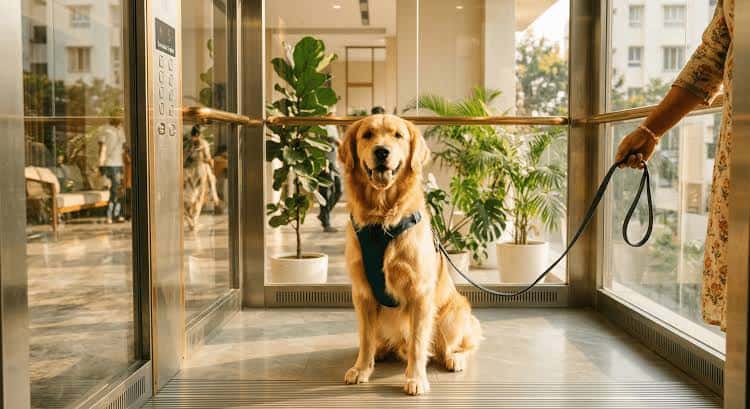
AWBI’s pet-dog guidelines state that pets cannot simply be prohibited from using lifts.
An association may advise residents that alternative arrangements are preferable in particular situations, but a blanket restriction preventing pets from using lifts can create serious practical difficulties, especially for residents living on higher floors.
Pet owners should nevertheless use lifts responsibly.
For example:
- Keep the dog under proper control.
- Avoid allowing it to jump on other passengers.
- Wait for another lift where necessary if someone is genuinely uncomfortable.
- Clean up immediately if the animal creates a mess.
Rights work best when accompanied by considerate behaviour.
Can an RWA Charge Extra Money for Using a Lift With a Dog?
Housing associations should not treat pet ownership as an opportunity to impose arbitrary penalties.
The AWBI guidelines have specifically opposed special charges imposed on pet owners for using lifts with their animals.
Ordinary maintenance obligations applicable to residents are one thing; imposing an additional lift charge solely because a resident has a pet is another.
If an association imposes such a rule, the resident can ask it to identify the legal basis and place the relevant resolution or bye-law in writing.
Can Dogs Use Apartment Parks and Common Areas?
An RWA should not impose unreasonable restrictions that effectively make keeping a dog impossible.
At the same time, pet owners cannot treat every common area as their private dog park.
Reasonable arrangements can be made to balance residents’ interests. For example, societies may identify appropriate areas or practices for exercising dogs, provided the restrictions are not discriminatory or so excessive that they effectively prohibit pet ownership.
Owners should prevent dogs from damaging property, frightening residents or leaving waste in common areas.
Is a Leash Compulsory in an Apartment Society?
Keeping a dog under control in common spaces is sensible and can be legally important.
AWBI guidance advises pet owners to use leashes in common areas while recognising that the nature of restraint should take account of the dog’s characteristics and welfare.
A leash helps prevent:
- Unexpected interaction with children;
- Dog fights;
- Running toward vehicles;
- Jumping on residents; and
- Accidental escapes.
Even a friendly dog may frighten someone who is uncomfortable around animals.
Responsible pet ownership means recognising that other residents have rights too.
Does a Pet Dog Need Vaccination?
Yes, responsible health management is an important legal obligation.
The Animal Birth Control Rules, 2023 specifically provide that the owner of a pet animal is responsible for its:
- Deworming;
- Immunisation
- Rabies vaccination is particularly important because dog bites can create serious public-health risks.
- Owners should maintain veterinary and vaccination records so they can establish the animal’s health status when necessary.
Is Dog Registration Required?
Pet registration requirements can exist under municipal or local laws and therefore may vary between cities.
A housing society’s rules should not be confused with municipal licensing requirements.
Depending on where you live, the local municipal corporation may require pet-dog registration and supporting documents such as vaccination details.
Pet owners should check the rules of their local municipal authority and renew registration where required.
What If Your Dog Barks and Disturbs Neighbours?
The legal right to keep a dog does not give an owner the right to create an unreasonable nuisance.
Occasional barking is normal animal behaviour. However, continuous barking for long periods—particularly when caused by neglect, lack of exercise or leaving the dog unattended—can create legitimate complaints.
Instead of treating every complaint as anti-pet behaviour, owners should identify the cause.
Possible solutions include:
- Adequate daily exercise;
- Behavioural training;
- Reducing separation anxiety;
- Veterinary examination where necessary; and
- Keeping the dog appropriately engaged.
An RWA may address a genuine nuisance. What it should not do is use one complaint as a reason to prohibit all pets throughout the society.
What Happens If a Pet Dog Bites Someone?
A dog owner has a responsibility to keep the animal under reasonable control.
If a dog attacks or injures another resident, the situation becomes more serious. Depending on the circumstances, issues of negligence, compensation, local municipal rules and other legal provisions can arise.
After a bite incident, the owner should:
- Ensure the injured person receives immediate medical attention.
- Provide the dog’s vaccination information.
- Cooperate with the competent authorities where required.
- Arrange veterinary or behavioural assessment if necessary.
- Take stronger precautions against another incident.
Repeated aggressive incidents should not be ignored merely because the owner considers the dog part of the family.
Can an RWA Force You to Abandon Your Dog?
An RWA should not force a resident to abandon a pet simply because the association has adopted a no-pet policy.
Abandoning an animal can itself raise issues under the Prevention of Cruelty to Animals Act, 1960.
AWBI has specifically noted that forcing citizens to abandon pets can result in cruelty to animals.
If an association objects to a particular dog’s behaviour, the appropriate approach is to address the actual problem—such as aggression, sanitation or uncontrolled movement—rather than demanding abandonment as the automatic solution.
What Should Responsible Apartment Pet Owners Do?
A pet-friendly legal framework does not eliminate the owner’s responsibilities. Apartment residents with dogs should:
- Follow applicable municipal registration requirements.
- Keep vaccinations and veterinary records updated.
- Deworm and sterilise the dog in accordance with applicable requirements.
- Keep the dog appropriately controlled in common areas.
- Pick up and properly dispose of pet waste.
- Prevent unnecessary nuisance to neighbours.
- Train dogs with behavioural issues.
- Avoid allowing dogs to threaten residents or other animals.
- Respect reasonable common-area arrangements.
- Never abandon a pet because of pressure from neighbours or an RWA.
The law therefore seeks a balance: apartment residents can generally keep pet dogs, while pet owners must ensure that exercising that right does not disregard animal welfare, public health, safety or the legitimate rights of their neighbours.
FAQs
Q1. Can my housing society tell me to remove my pet dog?
A. An RWA or apartment association should not impose an absolute pet ban or force residents to abandon pets merely because pets are generally prohibited under its internal policy. Genuine nuisance or safety issues involving a particular animal can still be addressed separately.
Q2. Can my apartment society stop my dog from using the lift?
A. AWBI guidelines oppose blanket prohibitions on pets using lifts. Owners should nevertheless keep dogs properly controlled and behave considerately toward other residents while using common facilities.
Q3. Can neighbours complain because my dog barks?
A. Yes, neighbours can raise a genuine nuisance complaint. Normal occasional barking is different from persistent disturbance. Pet owners should take reasonable steps to address excessive barking rather than relying solely on their right to keep the animal.
Q4. Is registration of a pet dog compulsory in India?
A. There is no single identical municipal registration procedure applicable to every city. Local bodies may require pet-dog registration or licensing, so owners should check the rules of their municipal corporation or local authority.