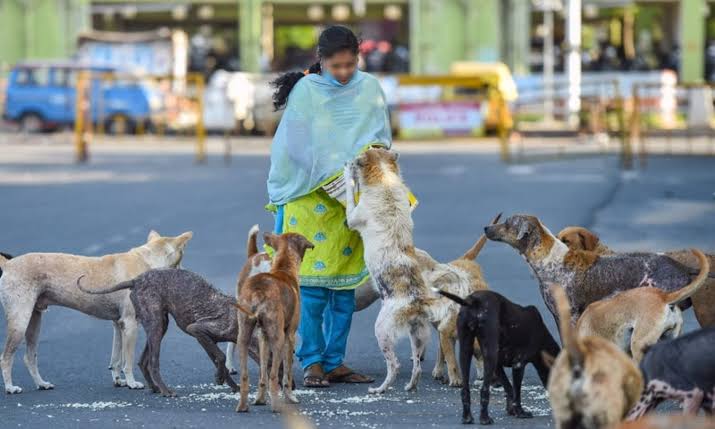
Giving food to a hungry street dog may look like a simple act of compassion, but the place where the food is offered matters legally. A person leaving food at an agreed feeding point in a residential colony is in a very different position from someone placing food every evening in the middle of a busy footpath, outside a school gate or beside a road where dogs gather around pedestrians.
Under the current legal framework, feeding stray or community dogs is recognised in India, but it cannot be done anywhere a feeder chooses. The Animal Birth Control Rules, 2023 provide for designated feeding arrangements, and the Supreme Court has subsequently directed that stray dogs should be fed in designated feeding areas rather than on streets and other public places.
The law therefore attempts to balance animal welfare with public safety, hygiene and the rights of other people using shared spaces.
What Do the Animal Birth Control Rules, 2023 Say?
The Animal Birth Control Rules, 2023, framed under the Prevention of Cruelty to Animals Act, 1960, contain a specific provision dealing with the feeding of community animals.
Rule 20 places responsibility on the Resident Welfare Association (RWA), Apartment Owners Association (AOA) or representative of the local body to make necessary arrangements for feeding community animals in consultation with residents who feed or care for them.
The feeding arrangement is not supposed to be random.
Designated feeding spots should take into account:
- The number of community dogs;
- Their territorial behaviour;
- Movement of children;
- Movement of senior citizens;
- Entry and exit points;
- Staircases; and
- Areas frequently used by residents.
Feeding times can also be fixed to reduce conflict between dogs, feeders and other residents.
What Did the Supreme Court Change in 2025?
This is crucial for understanding the present legal position.
In August 2025, the Supreme Court considered the growing problem of stray-dog attacks and the management of street dogs.
On 22 August 2025, the Court directed municipal authorities to create designated feeding spaces for stray dogs in every municipal ward.
The Court further directed that stray dogs should be fed only in those designated areas.
Importantly, the Court stated that feeding stray dogs on streets should not be permitted and that persons feeding dogs on streets contrary to the directions could face action under the relevant legal framework.
These directions were subsequently extended nationwide.
Therefore, older online advice saying, “You have an unrestricted right to feed stray dogs anywhere in a public place,” does not correctly reflect the present legal position.
Can You Feed Dogs on a Public Road?
You should not feed stray dogs indiscriminately on public roads.
Roadside feeding can create several practical risks.
Dogs may gather near moving vehicles, chase motorcycles or congregate around pedestrians. Leftover food can also create sanitation problems and attract other animals.
Under the Supreme Court’s current directions, municipal authorities are expected to establish designated feeding areas, and feeding should take place there rather than randomly on streets.
Compassion toward animals does not create a right to obstruct or endanger other road users.
Where Should Designated Feeding Areas Be Located?
Rule 20 provides useful guidance on how feeding locations should be selected.
Feeding spots should generally be located away from areas such as:
- Children’s play areas;
- Entry and exit points;
- Staircases; and
- Places frequently used by children and senior citizens.
The objective is not to prevent community dogs from receiving food.
Instead, it is to ensure that feeding occurs in a controlled location where dogs can eat without creating unnecessary conflict or risk to residents.
Municipal authorities and housing associations should therefore work with local animal caregivers instead of simply allowing random feeding throughout the area.
Can an RWA Completely Ban Feeding of Stray Dogs?
An RWA should not ignore the statutory framework by simply declaring that community animals will receive no feeding arrangement at all.
Rule 20 specifically places responsibility on RWAs, AOAs or local-body representatives to make necessary feeding arrangements where community animals reside in the area.
However, a feeder also cannot rely on Rule 20 to insist:
“I can feed dogs anywhere inside the society because feeding animals is my right.”
The Rules contemplate designated locations and times.
Both sides therefore have responsibilities.
The association should facilitate a lawful feeding arrangement, while feeders should respect the designated feeding system and maintain hygiene.
Can Someone Feed Dogs Outside Another Person’s House?
Feeding immediately outside somebody else’s entrance, gate or regularly used passage can create unnecessary conflict and may be inconsistent with the principles governing designated feeding areas.
If feeding causes dogs to gather near another resident’s entrance, that resident may have genuine safety and access concerns.
The better approach is to use the feeding location designated under Rule 20 or by the competent municipal authority.
A feeder’s compassionate intention does not mean another resident must accept a feeding point directly outside their home.
Who Is Responsible for Cleaning the Feeding Area?
Feeding must be accompanied by responsible sanitation.
Rule 20 requires the designated feeder to ensure that there is no littering at the feeding location.
After feeding, leftover food, disposable plates, packets and other waste should be removed.
This is particularly important because poorly maintained feeding locations can:
- Attract rats and insects;
- Produce unpleasant smells;
- Create disputes with residents;
- Contaminate common areas; and
- Make public opposition to community dogs worse.
Responsible feeding means providing food and cleaning the area afterwards.
What If a Stray Dog Bites Someone Near a Feeding Spot?
A dog-bite incident does not automatically make every person who has ever fed that dog legally responsible for the attack.
Liability depends on the actual circumstances.
However, known aggressive behaviour should never be ignored.
Under the Supreme Court’s 2025 directions, dogs infected or suspected to be infected with rabies and dogs exhibiting aggressive behaviour are treated differently from ordinary sterilised and immunised community dogs.
Serious incidents should be reported to the municipal authority or appropriate animal-control authority so that the dog can be assessed and handled according to the applicable rules.
A feeder should not obstruct lawful action involving a genuinely dangerous or rabies-suspected animal.
Can Stray Dogs Be Removed Just Because Residents Do Not Like Them?
The Animal Birth Control framework is based primarily on sterilisation and immunisation rather than indiscriminate removal or killing.
Municipal authorities are responsible for carrying out Animal Birth Control programmes, including sterilisation and anti-rabies vaccination.
Under the Supreme Court’s modified 2025 directions, sterilised and immunised dogs may generally be released back to the locality from which they were picked up, except dogs infected or suspected of being infected with rabies and dogs displaying aggressive behaviour.
Therefore, feeding disputes should not become an excuse for cruelty toward animals.
At the same time, animal welfare cannot be used to disregard genuine public-safety concerns.
What Should You Do If There Is a Dispute About Feeding?
Rule 20 provides a mechanism for resolving disputes concerning feeding arrangements.
Rather than engaging in arguments between residents and feeders, the issue should be taken through the appropriate RWA, AOA or local-body process.
A proper feeding arrangement should clearly identify:
- The designated feeding location;
- Suitable feeding times;
- Persons responsible for feeding;
- Cleanliness obligations; and
- Coordination regarding sterilisation and vaccination.
The Supreme Court has also directed municipal authorities to establish mechanisms for reporting violations concerning designated feeding arrangements.
How to Feed Community Dogs Responsibly
If you regularly feed stray dogs:
- Use only the designated feeding area.
- Follow the prescribed or mutually agreed feeding time.
- Do not feed dogs in the middle of roads or busy footpaths.
- Stay away from children’s play areas and entrances.
- Remove leftover food and waste.
- Assist with sterilisation and anti-rabies vaccination where possible.
- Report injured, sick or unusually aggressive dogs to the appropriate authority.
- Do not obstruct municipal officials lawfully performing their duties.
- Avoid creating large uncontrolled gatherings of dogs.
The current legal approach is therefore not “feeding is banned” and not “feeding is allowed everywhere.” Feeding community dogs remains recognised, but it must be organised through designated areas in a manner that protects both animal welfare and public safety.
FAQs
Q1. Is feeding stray dogs illegal in India?
Feeding stray dogs is not completely prohibited. However, under the current framework and Supreme Court directions, feeding should take place at designated feeding areas rather than indiscriminately on streets and other public spaces.
Q2. Can I feed stray dogs outside my apartment building?
Only if the location is consistent with the designated feeding arrangement applicable to the area. Entrances, exits, children’s play areas and other heavily used spaces should generally be avoided.
Q3. Can an RWA stop everyone from feeding community dogs?
An RWA cannot simply ignore Rule 20, which places responsibility on RWAs, AOAs or local-body representatives to make necessary feeding arrangements. At the same time, residents who feed dogs must follow designated locations, timings and cleanliness requirements.
Q4. Can I be punished for feeding dogs on the street?
Under the Supreme Court’s August 2025 directions, stray dogs are to be fed only in designated feeding areas, and persons feeding dogs on streets in contravention of those directions can be proceeded against under the relevant legal framework.