EV charging station vs petrol pump business is really a choice between two kinds of income. One pays a fixed cut on every litre you sell, no matter what the pump price does. The other pays whatever margin you can defend on each unit of electricity, but only if cars actually plug in.
Upfront Money: Lakhs Versus Crores
The entry ticket for the two businesses differs by a factor of ten or more.
- Petrol pump: oil companies charge an application fee, then a fixed fee of about ₹15 lakh (₹5 lakh for rural sites) on dealer-owned land, or a bid starting around ₹30 lakh on corporation-owned sites.
- Development runs roughly ₹50 lakh to ₹1.5 crore for rural outlets and ₹1.5 to 3 crore-plus for urban or highway ones, with land extra.
- Working capital of ₹10–25 lakh or more is needed, since fuel stock is effectively cash-and-carry.
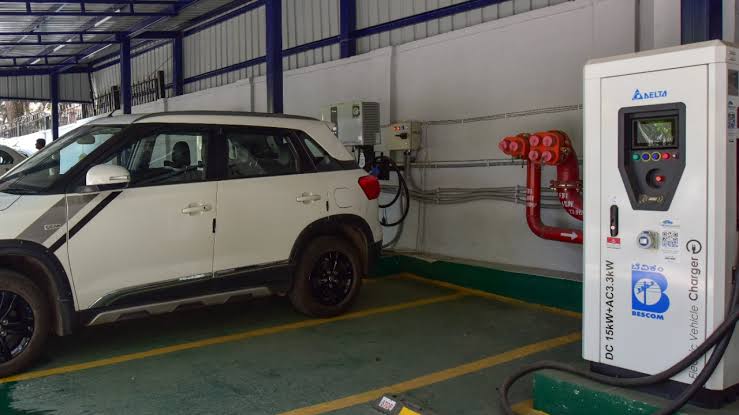
- EV station: AC setups start around ₹1.5–3 lakh, DC fast-charger stations range from about ₹4 to 25 lakh, and large hubs cross ₹1 crore.
- A 30 kW DC charger is a common first buy. One vendor models it at ₹12 lakh all-in.
How Each One Actually Earns
A petrol dealer is paid per litre at a rate someone else sets, while an EV operator earns the spread between buying and selling power.
- Petrol dealers earn a commission fixed by oil companies. Sources disagree on the current rate: some put the base at about ₹3.14 per litre on petrol and ₹2.33 on diesel since December 2024, others at ₹3.7–4 and ₹2.5–2.9.
- An average outlet selling around 170 kilolitres a month grosses roughly ₹5–5.5 lakh. After staff, power, losses, card charges and the oil company’s licence fee, net commonly lands at 30–50% of that.
- EV operators buy power from the DISCOM at concessional tariffs of about ₹5–6.50 per kWh and sell it at ₹12–18 at public stations, and up to ₹25 at premium fast chargers. Gross margin is roughly ₹6–12 per kWh.
- Public charging service charges also depend on state rules, so check yours before pricing.
The Utilisation Trap
Both businesses live or die on volume, and both take time to build it.
- One vendor’s model says a ₹12 lakh, 30 kW charger with ₹45,000 monthly running costs needs about 9–10 sessions of 20 kWh a day to break even at ₹18/kWh.
- Add a ₹3 lakh subsidy and, at 50% utilisation, payback shortens to about 42 months.
- New stations typically see only 15–25% utilisation in their first six months, so model year one low.
- Petrol pumps carry a similar location gamble. Highway outlets selling 8,000-plus litres a day are pitched at 2–3 year paybacks, while rural pumps under 2,000 litres a day may need 5–7 years.
- These paybacks are vendor and dealership-consultant estimates, not audited returns.
Getting In: Draws Versus Paperwork
Petrol pumps are won through an oil company process, while EV stations mostly need clearances and a grid connection.
- Petrol pump sites are advertised by oil companies and awarded through a draw or bid. Winners pay a share of the security deposit within days, and it’s forfeited if licences don’t come through.
- EV charging needs no electricity distribution licence, but five other regulatory steps still apply, plus a DISCOM connection.
- Many attractive sites, especially older buildings and highway plots, lack the electrical capacity for DC charging. Upgrade costs and timelines can sink a project.
- The PM E-DRIVE scheme earmarks ₹2,000 crore for chargers, with subsidy coverage varying by location and equipment. One source says you must apply before installation.
Where Each One Is Exposed
Each model has a weak point that brochures tend to skip.
- A petrol dealer’s commission can’t be negotiated. The October 2024 revision was the first in eight years, while wages and power costs kept climbing.
- Petrol and diesel are still expected to dominate Indian fuel demand for decades, so volume risk is slow-moving.
- India had 29,151 public EV charging stations as of the December 2025 update, 8,805 fast and 20,346 slow. Vendors estimate the country needs around 1.3 million by 2030.
- That gap looks like opportunity, but it also invites crowded locations.
The Detail Most Comparisons Miss
The two businesses aren’t strict rivals, and the industry is already blending them.
- Pump owners are adding chargers, and Shell says 325-plus of its Indian fuel outlets now offer EV charging.
- A fuel station already has the land, footfall and dwell time that a standalone charger has to buy or hunt for.
- That makes charging a stronger add-on for existing sites than a stand-alone bet.
Who Should Pick What
The right choice depends mostly on your capital, land and patience.
- Choose the petrol pump if you own suitable roadside land, can arrange ₹1 crore or more, and want income tied to volume rather than pricing skill.
- Choose the EV station if you have a smaller budget, a high-dwell site like a mall, hotel or fleet hub, and patience through a slow ramp-up.
- Choose both if you already hold a fuel site and can fund the grid upgrade.
FAQs
Q1. Which needs less investment, a petrol pump or an EV charging station?
A. An EV station, by a wide margin. AC setups start around ₹1.5–3 lakh, while a petrol pump needs roughly ₹50 lakh to 3 crore for development, plus working capital and land.
Q2. Do I need a licence to sell electricity from an EV charger?
A. No electricity distribution licence is required, but other clearances and a DISCOM connection still are. Rules vary by state, so confirm requirements with your local DISCOM before buying any equipment.
Q3. How much does a petrol pump dealer earn per litre?
A. Commission is fixed by oil companies, not the dealer. Sources differ: about ₹3.14 on petrol and ₹2.33 on diesel as the base since December 2024, while others quote ₹3.7–4 and ₹2.5–2.9.
Q4. Can one site run both businesses?
A. Yes. Pump owners are adding charging points for extra revenue, and Shell reports 325-plus Indian fuel outlets with EV charging. You’ll need extra capital and enough grid capacity for the chargers.