The 7-5-3-1 rule is a practical framework for setting realistic expectations about mutual fund returns — specifically, how often investors should expect to feel disappointed even while their investments are on a perfectly healthy long-term trajectory. It was not formulated by SEBI or any regulatory body but emerged from financial planning practice as a way to communicate the statistical reality of equity investing in a format that investors can remember and apply. Understanding this rule prevents the single most destructive investor behaviour: redeeming good investments during normal performance cycles because short-term returns did not meet expectations.
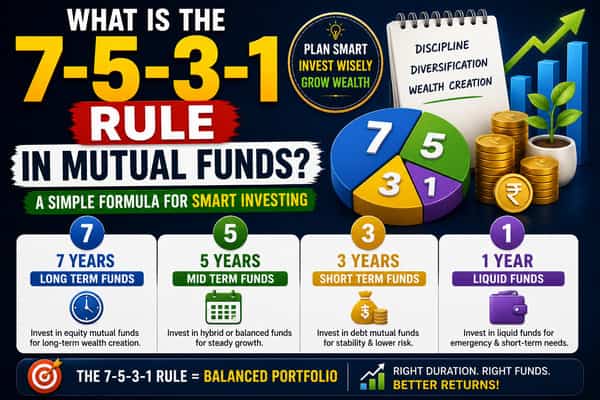
The Four Numbers Explained
7 out of 10 Years — Equity Funds Will Likely Deliver Positive Returns
In any given calendar year, equity mutual funds — measured against broad indices like Nifty 50 or Nifty 500 — have historically delivered positive returns approximately 7 out of every 10 years. This means 3 out of every 10 years will produce negative returns. An investor who has been in equity funds for 5 years can statistically expect to have experienced 1 to 2 negative-return years within that period. These negative years are not failures of the fund or the investor’s strategy — they are the normal pattern of equity market behavior. Panicking and exiting during these expected negative years destroys the return that the positive years would have delivered.
5 of Every 7 Benchmarks — Active Funds Underperform the Index
Over sufficiently long periods (5+ years), approximately 5 out of every 7 actively managed mutual funds underperform their benchmark index after accounting for expenses. This is not an argument against all active funds — some genuinely skilled fund managers consistently outperform — but it is the statistical reality that most retail investors face when selecting active funds. The implication is that index funds should form the core of most long-term portfolios, with active funds supplementing rather than replacing passive exposure. Selecting the 2 out of 7 active funds that consistently outperform requires either genuine research capability or significant luck.
3 Years — The Minimum Meaningful Performance Evaluation Period
Evaluating an equity mutual fund’s performance over periods shorter than 3 years produces noise, not signal. A fund that underperforms for 1 year may be experiencing a style cycle — value funds underperforming during growth-led rallies, mid-cap funds lagging during large-cap-driven years — that will naturally reverse without any change in fund quality. Three years of data across different market conditions provides the first meaningful window to assess whether a fund’s performance deviation is structural or cyclical. Most retail investors abandon funds after 12 to 18 months of underperformance — which is almost always too early to make this judgment.
1 Fund Manager — The Underappreciated Single Point of Risk
A mutual fund’s performance depends significantly on the fund manager — the individual whose investment decisions determine what the fund buys, holds, and sells. When a successful fund manager changes roles or leaves an AMC, the fund’s future performance may diverge from its historical record. Investors who buy a fund primarily because of its historical performance under a specific manager should monitor manager continuity and reassess if key managers change. This is also the argument for index funds — their performance is determined by the index, not by any individual manager, eliminating this single point of risk entirely.
How to Apply the 7-5-3-1 Rule in Practice
When markets produce a negative year (the 3 in 10 expectation): do not interpret it as fund failure. Review whether your fund’s relative performance — versus its benchmark and category peers — has been reasonable. If it has, stay invested.
When your active fund underperforms for a year or two: apply the 3-year standard before drawing conclusions. Only after 3 years of consistent underperformance relative to the category average should you consider switching.
When selecting new funds: check whether the current fund manager has been managing the fund for the period of historical performance you are relying on. Historical returns under a previous manager are less predictive of future returns.
Overview Table: The 7-5-3-1 Rule Components
| Number | What It Means | Practical Implication |
| 7 | 7 of 10 years, equity funds deliver positive returns | Expect 3 negative years per decade; do not panic-exit |
| 5 | 5 of 7 active funds underperform their benchmark | Use index funds as core portfolio; be selective with active funds |
| 3 | Minimum 3 years to meaningfully evaluate fund performance | Do not abandon funds after 1–2 years of underperformance |
| 1 | Fund manager is a single point of risk | Monitor manager continuity; prefer index funds to eliminate this risk |
What the Rule Does Not Cover
The 7-5-3-1 rule addresses investor expectations about frequency and duration of performance cycles — not the magnitude of returns or the suitability of specific fund categories for specific goals. It should be used alongside other frameworks: the appropriate investment horizon (5+ years for equity), fund category selection based on risk tolerance, and tax planning for redemptions.
Frequently Asked Questions (FAQs)
Q1. What is the 7-5-3-1 rule in mutual funds?
A memory framework: equity funds deliver positive returns 7 out of 10 years; 5 of 7 active funds underperform their benchmark; evaluate performance over minimum 3 years; and 1 fund manager is a single point of risk worth monitoring.
Q2. How does the 7-5-3-1 rule help prevent panic selling?
By establishing that negative return years (3 out of every 10) are statistically expected — not indicators of fund failure — it gives investors a rational framework to stay invested during bad years rather than redeeming at a loss.
Q3. Does the 7-5-3-1 rule support investing in index funds?
Yes — the “5 of 7 active funds underperform their benchmark” component is a strong argument for index funds as portfolio core. Index funds by definition match the benchmark rather than underperform it.
Q4. Is 3 years long enough to evaluate a mutual fund?
Three years is the minimum meaningful window — sufficient to see performance across at least one partial market cycle. Five to seven years is the more reliable evaluation period for a comprehensive assessment.
Q5. Should I change my fund if the fund manager changes?
Not immediately — but monitor the new manager’s first 6 to 12 months of performance relative to peers. A manager change is a trigger to reassess, not automatically to exit. The 3-year evaluation standard still applies after reassessment begins.