Running a business across multiple locations used to mean managing multiple networks, each with its own configuration, connectivity setup, and set of problems to troubleshoot. IT teams spent more time managing branch connectivity than supporting the work happening on top of it. SD-WAN emerged from a straightforward frustration with that model, and it has considerably changed how multi-branch businesses approach their managed network services.
Understanding what it actually does and why it matters for businesses operating across locations is worth doing properly before making any infrastructure decisions.
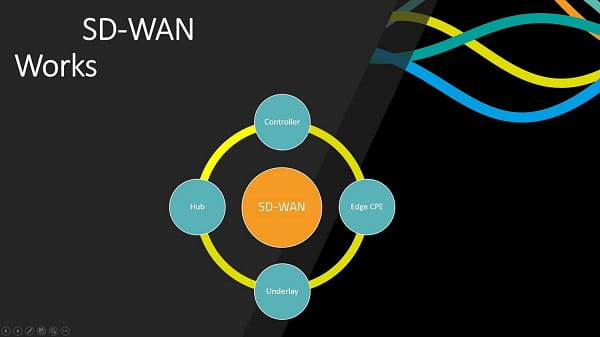
What SD-WAN is and what problem it solves
SD-WAN stands for Software-Defined Wide Area Network. A WAN (Wide Area Network) is the infrastructure that connects geographically separate offices, branches, or locations into a single coherent network. Traditionally, this was done through dedicated private circuits that were expensive, rigid, and difficult to change as the business evolved.
SD-WAN replaces that hardware-dependent model with a software layer that sits across whatever connectivity links the business is already using, whether broadband, leased lines, 4G, or a combination, and manages traffic across all of them intelligently from a centralised control point.
The result is a corporate internet connection that is more flexible, more resilient, and significantly easier to manage across multiple sites without requiring specialist engineers at every location.
How it works in a multi-branch environment
The core of what makes SD-WAN useful for multi-branch businesses is intelligent traffic management. In a conventional WAN setup, traffic between branches follows a fixed path regardless of conditions. If that path is congested or encounters an issue, performance degrades, and there is no automatic correction.
WAN in computer networks built on SD-WAN works differently. Traffic is continuously monitored across all available links, and applications are automatically routed through the most reliable path at any given moment. If one link degrades, traffic shifts to another without manual intervention and without users noticing any disruption.
For businesses running critical applications across branches, that automatic rerouting is the difference between a minor network event and a full operational disruption affecting multiple locations simultaneously.
How is it beneficial for multi-branch businesses?
The complexity of managing corporate internet connection quality across multiple locations grows quickly. Each branch has its own users, devices, and applications competing for bandwidth. Without centralised visibility and control, problems at one location are slow to surface and slower to fix, leaving IT teams managing incidents after they have already affected the working day.
Managed network services built on SD-WAN address this by giving the business a single view across every location. Performance, usage, and connectivity status across all branches are visible from one interface, and configurations can be pushed to any site without anyone travelling there to make changes.
For growing businesses adding new locations regularly, this matters practically. Bringing a new branch online does not require significant on-site setup. It connects into the existing WAN in the computer networks framework, policies apply automatically, and the branch is operational far more quickly than a traditional setup would allow.
Security across branches is also handled centrally rather than each location managing its own protection separately, which reduces the gaps that tend to develop in distributed networks managed site by site.
Choosing the right option: Spectra’s Managed SD-WAN
Among providers offering managed network services with SD-WAN capability, Spectra has built a solution specifically for businesses where work spans multiple locations and the WAN (Wide Area Network) needs to stay coordinated across all of them.
Rather than leaving the business to configure and manage the SD-WAN layer itself, Spectra takes full ownership of the service. What that looks like in practice:
- Intelligent traffic steering that automatically routes business applications through the most reliable available path.
- Multi-link resilience keeps the corporate internet connection running across locations even when individual links encounter issues.
- Centralised network control across all branch locations through a single management platform.
- Secure branch networking with integrated security policies protecting traffic between offices.
- Full network visibility with real-time performance and traffic monitoring across every site.
- Automatic prioritisation of business-critical applications to maintain consistent performance under load.
Conclusion
Multi-branch businesses need their locations to behave as a single, coordinated network rather than a collection of separate connections that happen to share a name. WAN in computer networks built on SD-WAN is how that coordination happens, and properly managed network services around it are how it happens without placing the full management burden on the business itself.
Reach out to Spectra’s team today and explore how managed SD-WAN can bring clarity, control, and reliability to every location your business operates from.